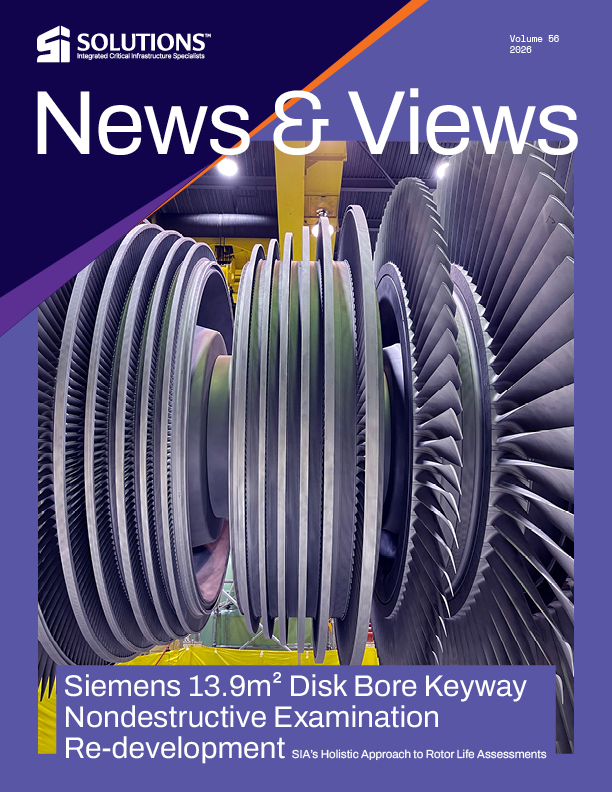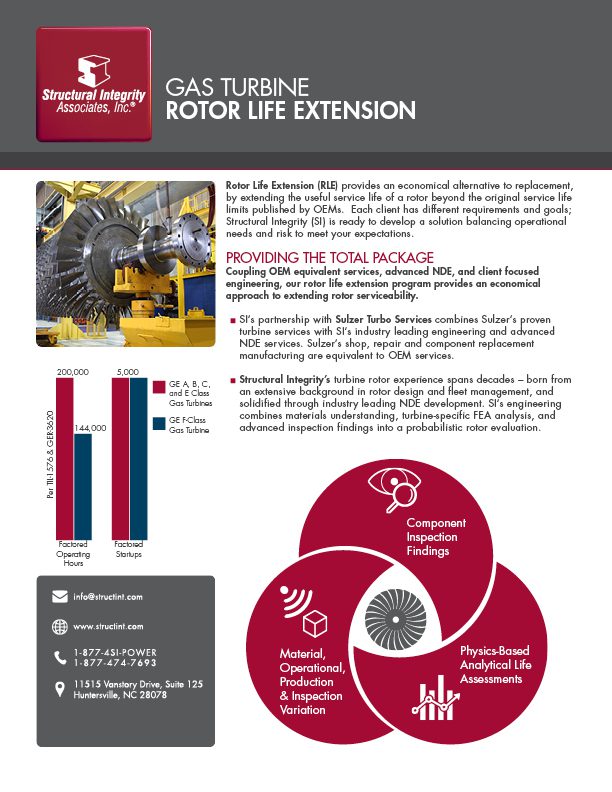

The cover of this issue features a longstanding inspection challenge in nuclear power: achieving full ultrasonic coverage of shrunk-on disk bore and keyway regions on a Siemens 13.9m² low-pressure turbine rotor — without de-stacking the rotor. SIA redeveloped its automated phased array ultrasonic testing protocol using advanced CAD modeling and simulation, achieving 100 percent disk bore coverage across all six disks within a predictable five-day outage. The validated protocol supports defensible rotor life assessments for nuclear utilities.
Issue 56 also opens with a letter from SI Solutions President & CEO Mark W. Marano — covering three recent platform acquisitions, organizational investments, and the launch of SI Solutions’ sharpened brand identity as the Integrated Critical Infrastructure Specialists.
But Issue 56 ranges well beyond the turbine hall. Inside, you’ll find fourteen technical articles spanning the critical infrastructure industries we serve:
Pipeline integrity – How a first-of-its-kind ECA methodology is giving pipeline operators a defensible alternative to hydrostatic retesting or full replacement of legacy lap-welded pipe
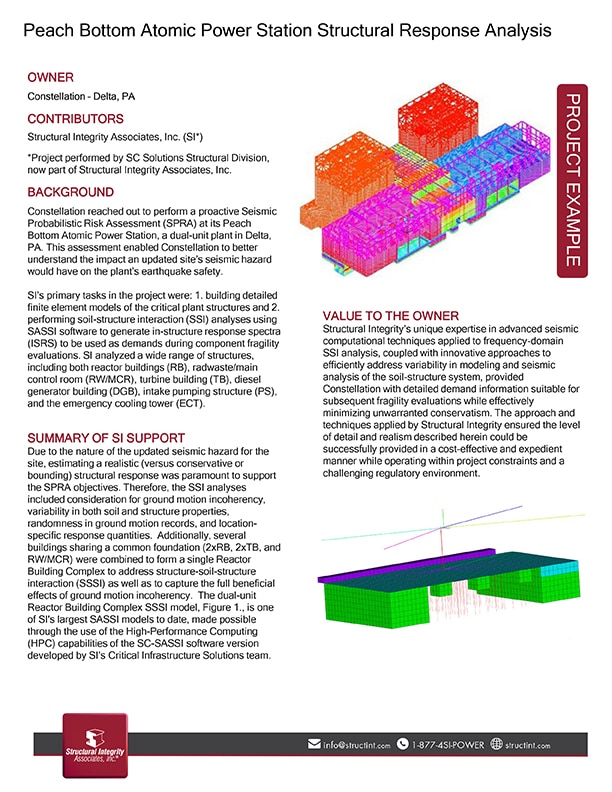
Seismic engineering – What operators need to know about seismic qualification as BESS deployments move into higher-risk zones — plus how friction-pendulum isolation technology is keeping critical Pacific Northwest infrastructure operational after major seismic events
Materials and damage mechanisms – Why stress corrosion cracking in boiler and HRSG tubes is often further along than the first leak suggests; what separates a rigorous failure analysis from an inconclusive one; and how a hybrid CP system redesign raised protection coverage from roughly 50 percent to more than 85 percent at a nuclear generating station
Nuclear and advanced reactors – How flaw tolerance analysis and Leak-Before-Break assessments are supporting advanced reactor licensing under ASME’s RIM framework — and what coatings degradation evaluations need to address to satisfy license renewal requirements
Project delivery – Lessons from delivering new-to-site process technology on an accelerated FEED-to-IFC schedule — and how concurrent engineering and rapid field mobilization restore fire-damaged electrical and instrumentation systems before the damage scope is even fully known
Vibration and fatigue – A passive retrofit solution that reduced vibration by up to 46 percent and cut equivalent stress at critical socket weld locations by more than 90 percent
Emerging technology – How physics-based digital twins are enabling real-time fault detection in semiconductor fabrication equipment — and a framework for using AI to transform decades of scattered asset inspection records into a validated, engineering-accountable single source of truth