By: John Svet, PE and Grant Wu, PE
INTRODUCTION
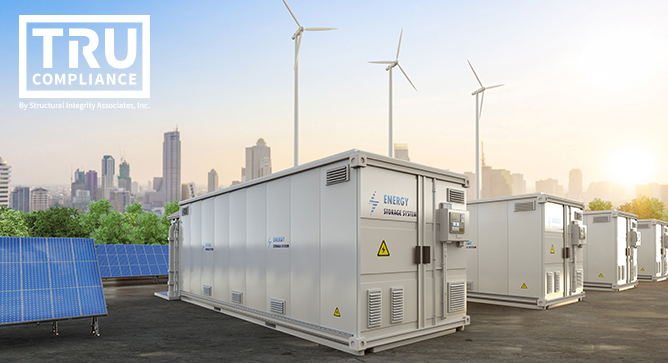
Battery Energy Storage Systems (BESS) are rechargeable battery systems that can store and distribute energy from various sources. BESS are increasingly used to optimize the electric grid for energy supply and demand, and to support the shift toward renewable energy and a more electrified society. BESS allow energy to be stored when it is cheaper to produce, then released back to the grid when demand and prices increase. Some BESS are being deployed in seismically active regions, making seismic qualification and certification critical to ensure the systems’ resilience and prove their structural integrity and functionality after seismic events.
Seismic qualification helps to ensure that BESS can withstand design-level earthquakes without compromising life safety, structural integrity, or operational functionality, depending on the application. Qualification is typically required for modular or containerized BESS units, utility-scale installations, and critical facilities (e.g., hospitals, emergency response centers, substations). These qualifications usually address some or all of the following: structural resistance of the seismic forces, anchorage, and mounting of the frame and internal components to ensure position retention, post-event functionality, and fire and life safety hazards.
SEISMIC REQUIREMENTS
Different performance levels may be required depending on the codes and standards that need to be met, the seismicity of the project site, and the risk category or critical nature of the facility.
Low seismic regions are defined differently in various codes and standards. These low seismic regions may only require an anchorage position-retention design or even have no seismic requirements at all. Position retention calculations ensure the BESS do not slide or tip during a seismic event.
In moderate and high-seismic regions, structural integrity verification is typically required. Such evaluations ensure that the BESS do not collapse during a seismic event.
Finally, functional verification may be required depending on whether the facility is deemed essential (e.g., hospitals), if the BESS contain hazardous materials, and/or the battery systems need to operate after an earthquake. This functional verification ensures the BESS continue to operate or can be restarted after a seismic event. Grid-stabilizing BESS or emergency backup systems often fall into this category as well.
SEISMIC QUALIFICATION METHODS
Seismic qualification of BESS may involve analysis, testing, or a combination of the two, depending on the complexity and size of the BESS and the risk level of the installation. Experience data generally is an acceptable method for seismic qualification of nonstructural components and equipment. However, rapidly changing battery technology means that the current generation of BESS may not be certifiable using data from previous systems.
Analysis can be used to prove structural integrity and position retention of the BESS. Depending on the code or standard, analyses could be static or dynamic. Static analysis is the default analysis method for the American Society of Civil Engineers’ ASCE 7 Standard, and is referenced by the International Building Code (IBC).
For electrical substations, the type of analysis used depends on the size and dynamic behavior of the BESS. Small rigid systems can be evaluated via static analysis. Larger non-rigid systems should be analyzed using dynamic methods, such as response spectrum or time-history analysis. Finite element models are used increasingly, especially for dynamic analyses.
Testing is another method to validate the structural integrity of the system, with one notable difference. Testing is the only way to prove post-event functionality was maintained. This is performed via shake-table testing, which simulates seismic demands by way of input ground motions. Functionality of the equipment is performed before and after the test to verify continued operability.
CODES and STANDARDS
Depending on the type of facility or jurisdiction in which the BESS will be installed, there may be different requirements for the unit’s seismic performance and the seismic qualification method used. The most common codes, standards, and jurisdictions include IEEE 693, the International Building Code, ASCE 7, the California Building Code (CBC), and the California Division of the State Architect (DSA).
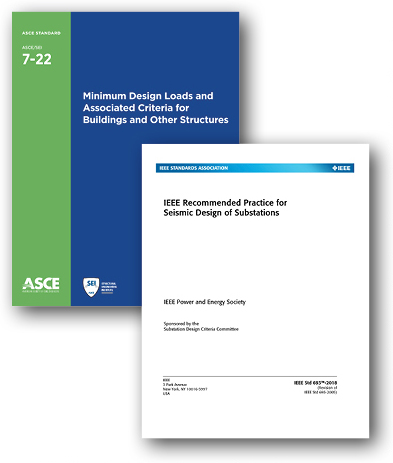
IEEE 693 is the standard for Seismic Design for Electrical Substations. This standard applies to electrical equipment installed at substations, including BESS. There are three seismic levels: low, moderate, and high, depending on the substation’s location. These seismic levels, along with the manner of construction of the BESS, determine the level of analysis or testing required to demonstrate seismic qualification.
The International Building Code (IBC, Chapter 16) specifies seismic design requirements for all structures, including BESS. This Section states that every structure shall be designed and constructed to resist the effects of earthquakes in accordance with the seismic chapters of ASCE 7.
ASCE 7 details the Minimum Design Loads for Buildings and Other Structures. Depending on the size and construction of the BESS, Chapter 13 for nonstructural components combined with Chapter 15 for nonbuilding structures may apply. These chapters, along with references to other chapters in ASCE 7, define the seismic requirements and loading, performance objectives, and acceptable qualification methods. This includes references to test standards such as the International Code Council’s ICC-ES AC156.
The California Building Code applies in California and is based on the IBC, but with some California-specific amendments. The CBC makes similar references to ACSE 7 for defining the structural and seismic requirements of structures, systems, and components such as BESS.
California Division of the State Architect (DSA) oversees approvals for public schools and state buildings. DSA has published an interpretation of regulations notice (IR N-4) that clarifies specific code requirements for modular BESS. Like IBC and CBC, this document relies on ASCE 7 for defining structural calculation, shake-table testing, and other requirements.
While there are codes for other jurisdictions, each with their own requirements, the above standards cover most applications.
STRUCTURAL INTEGRITY ASSOCIATES’ CAPABILITIES
Structural Integrity Associates and its subsidiary, TRU Compliance, worked with multiple BESS manufacturers to qualify and certify their systems for various seismic requirements.
TRU Compliance maintains a network of test laboratory partners across the United States and globally. With this network, we are able to tailor test programs to fit the project’s needs in terms of schedule, location, and facility shake-table size. Additionally, Structural Integrity uses industry-leading software packages such as ANSYS and AbaqusTM, among others, to accurately model BESS and capture their dynamic performance and structural resilience during an earthquake.
Combining all of these aspects allows Structural Integrity and TRU Compliance to provide a turn-key solution to guide BESS manufacturers and end users through the seismic qualification process and obtain successful outcomes.
CONCLUSION
Seismic qualification of BESS are a multifaceted process involving analysis, testing, and compliance with jurisdiction-specific codes and standards. As BESS deployments grow, adherence to these standards is essential to protecting infrastructure, lives, and grid reliability.
Structural Integrity’s team of licensed engineers has expertise and experience with the various codes, standards, and jurisdictions for seismic qualification of BESS. We can help you navigate these requirements and provide the most suitable evaluation method for your circumstances.
DOWNLOAD FULL ISSUE