By: Curtis Strauss
Learn how an existing, underperforming cathodic protection (CP) system was technically evaluated and modernized to meet current effectiveness expectations, without full replacement.
OVERCOMING A COMMON CHALLENGE
When planning for extended operation, many nuclear energy facilities face the common challenge of determining how best to address aging infrastructure, specifically whether to repair, augment, or fully replace existing systems. U.S. nuclear energy plants entering subsequent license renewal (SLR) with existing cathodic protection systems often must evaluate the original CP system design basis and related assumptions. Plant operators also assess the overall condition and capability of the existing system to ensure it meets current and future needs.
In 2024, Xcel Energy contracted with Structural Integrity Associates (SIA) to conduct a feasibility and design study for a cathodic protection system at the Monticello Nuclear Generating Plant (MNGP). Following the design study, SIA developed a detailed design basis for a supplemental CP system intended to meet the site’s regulatory commitments for SLR, supporting continued operations through September 8, 2050.
For sites such as Monticello with long-serving CP infrastructure, the appropriate path forward is site-specific and depends on multiple technical and regulatory factors, including:
- Age, condition, and demonstrated effectiveness of the existing CP system
- Required service life of the system to support extended operation
- The continued applicability of the original CP design basis
- Changes in plant configuration since the original system was installed
- Changes in the scope of systems, structures, and components requiring protection
- Evolution of regulatory guidance and aging management expectations
The details in this article demonstrate the evaluation, design, and implementation of a site-wide CP system upgrade at Monticello Nuclear Generating Plant, developed within this decision framework, to support effective aging management during the subsequent period of extended operation (SPEO).
EXISTING CATHODIC PROTECTION SYSTEM
Cathodic protection for buried piping and tanks was first introduced at MNGP as part of the original site design and construction in 1970. The original system included a combination of distributed impressed current cathodic protection (ICCP) and galvanic anode CP (GACP). This system was designed to protect key buried assets such as cooling water lines, radioactive waste piping, fuel tanks, and condensate tank bottoms. The system was not site-wide, nor was it intended to cover the specific buried piping and tanks now identified within the SLR scope. Over time, reliability issues, depleted anodes, and site modifications necessitated the installation of a replacement ICCP system.
In 2010, a new sitewide ICCP system was installed, consisting of five rectifiers and semi-deep anode groundbeds. This system was designed with a total capacity of 150 amperes of direct current (ADC), but over time the individual circuit resistance of the groundbeds limited the actual output to approximately 95 ADC. Records indicate that additional semi-deep anode groundbeds were included in the design; however, they were never installed.
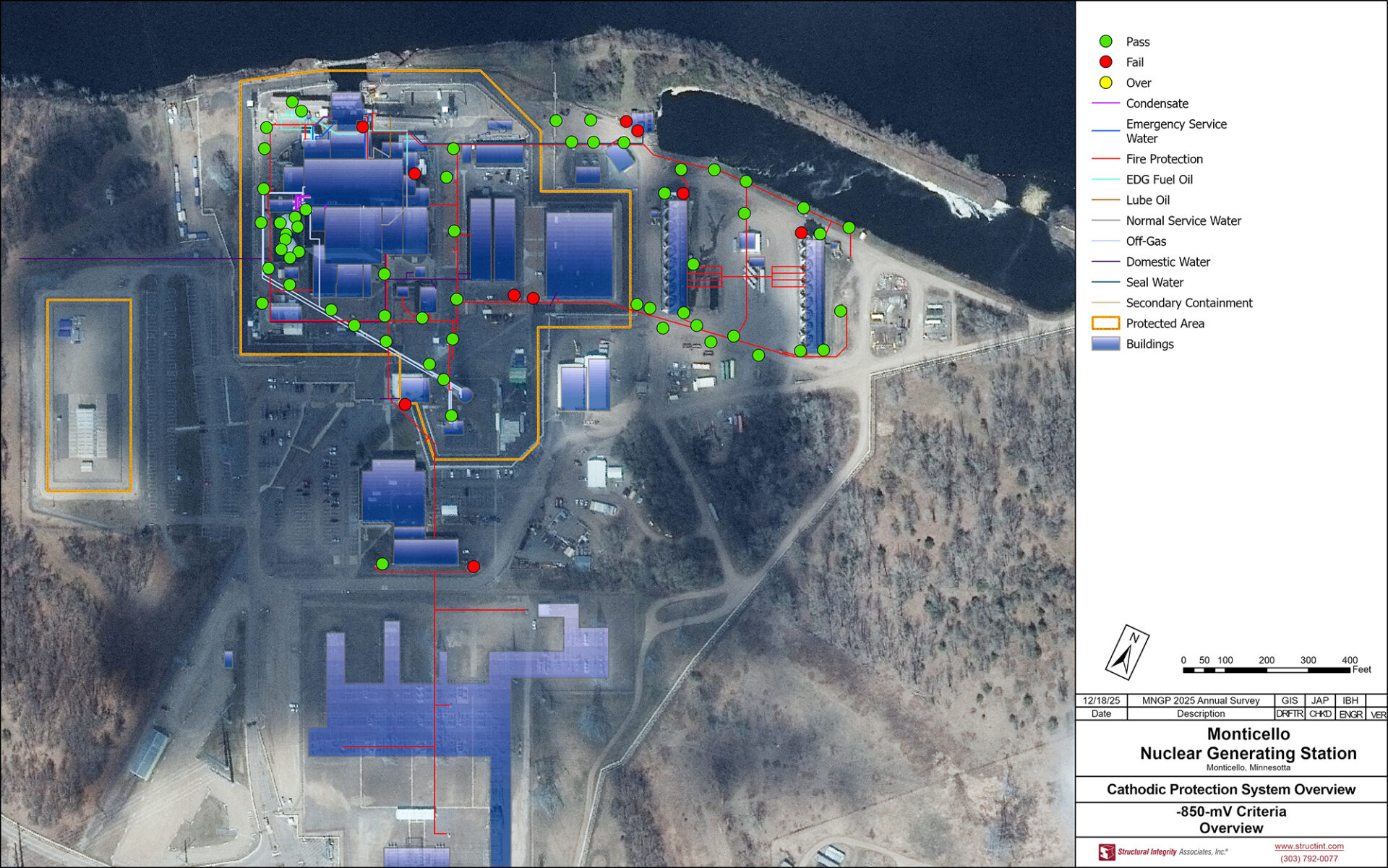
CP performance is monitored annually, and evaluations were expanded in 2021 to survey the entire facility. The 2021 survey showed that approximately 50 percent of monitored test points did not meet the required CP acceptance criteria. Adjustments to the rectifier outputs yielded limited improvements and indicated that the system, in its current form, was both undersized and provided inadequate current distribution. It was determined that a significant CP system upgrade or replacement would be needed to increase available current and improve distribution. This would help to ensure the protection of all SLR in-scope buried piping and tanks.
ASSESSMENT METHODOLOGY
The feasibility and design study evaluated the condition, performance, and limitations of the existing CP system to determine whether refurbishment, augmentation, or full replacement would be required to support Monticello Nuclear Generating Plant’s SLR commitments. A secondary objective was to assess whether a sitewide CP system would be practical given the plant’s physical and operational constraints.
The evaluation drew on three primary workstreams: a review of historical documentation and operating data; targeted field testing and site walkdowns; and direct discussions with station personnel and contractors to characterize construction and installation constraints.
1. Review of Historical CP Surveys and Rectifier Data
Historical CP performance was assessed through annual survey data, rectifier operating records, and supporting documentation spanning decades of system operation. Particular emphasis was placed on the expanded survey efforts conducted between 2021 and 2024. Those results consistently showed that a significant portion of monitored test points failed to meet the −850-mV copper sulfate electrode (CSE) polarized potential criterion specified by applicable U.S. NRC guidance, with approximately half of all monitored locations remaining underprotected even at maximum rectifier output. This pattern indicated a systemic limitation rather than localized piping issues, such as isolated coating defects.
Rectifier operating data told a similar story. The five existing rectifiers were originally designed for a combined output of approximately 150 ADC, but, at the time of the study, measured circuit resistances constrained the practical output to 90–100ADC under normal operating conditions. Incremental voltage increases produced diminishing returns, confirming that circuit resistance and current distribution, not rectifier capacity alone, were limiting the system’s effectiveness. The rectifiers and above-ground components, such as anode junction boxes, were found to be in generally good condition, with no near-term concerns regarding their remaining service life. The anode groundbeds, however, showed varying degrees of degradation and would likely require replacement before the end of the SPEO, consistent with their original design intent.
2. Identification of System Deficiencies
Correlating the survey results, rectifier operating limits, and site configuration constraints revealed several compounding deficiencies: insufficient total current capacity relative to the expanded SLR scope; poor current distribution to congested areas; and limited ability to mitigate shielding and attenuation effects caused by buried plant infrastructure and grounding systems. The assessment also found that the legacy CP system design basis was no longer aligned with current regulatory expectations or the buried piping scope required for the full SLR interval. Based on these findings, refurbishment of the existing system alone was deemed insufficient.
3. On-Site Testing and Walkdowns
To validate design assumptions and characterize current site conditions, SIA conducted on-site testing focused on two critical variables: electrical continuity of buried piping systems and soil conditions across the facility. Soil resistivity testing revealed significant spatial and depth-dependent variability, with shallow soils ranging from approximately 1,900 Ω-cm to greater than 76,000 Ω-cm, a range that directly influenced assumptions about required current capacity, anode configuration, and rectifier specifications.
Site walkdowns and discussions with station personnel identified the constructability constraints that any new CP infrastructure would need to navigate, including dense buried utilities, plant grounding systems, structural foundations, and Protected Area limitations. SIA used these findings to develop a preliminary sitewide system design and to validate its potential feasibility against logistical challenges. While the preliminary design required several revisions, key stakeholders ultimately concluded that a sitewide CP system was both feasible and capable of delivering effective long-term protection.
4. Upgrade Versus Replacement Considerations
Evaluation of the existing CP system weighed full replacement against targeted augmentation of legacy infrastructure, considering site constructability constraints, anticipated performance improvements, and long-term operation and maintenance factors.
Full replacement would have required removal or abandonment of existing anode groundbeds, cabling, and rectifiers, all of which had years of serviceable life remaining. This would also increase construction complexity, particularly within the Protected Area. Augmentation avoided or delayed those costs and complications by reusing serviceable components and minimizing the near-term excavation scope.
Historical performance evaluations reinforced this direction. The identified deficiencies were driven primarily by insufficient current capacity and poor current distribution, rather than by widespread component failure, meaning that targeted augmentation offered a clear path to compliance with applicable CP acceptance criteria by supplementing the existing CP infrastructure.
A hybrid design incorporating continued use of existing groundbeds alongside supplemental anode capacity was therefore identified as both technically justified and the most cost-effective path forward.
SELECTED UPGRADE STRATEGY
The selected strategy retained the existing five ICCP anode groundbeds and rectifiers while adding two forms of supplemental capacity. First, one additional semi-deep remote anode groundbed, similar in construction and capacity to those already in service, was specified to improve system balance and optimization. This was particularly true for buried piping near the cooling tower, where under- and over-protection had been recurring concerns. Leveraging the existing design for this addition minimized engineering change effort and allowed the substantial operational data from existing installations to inform the new semi-deepwell design.
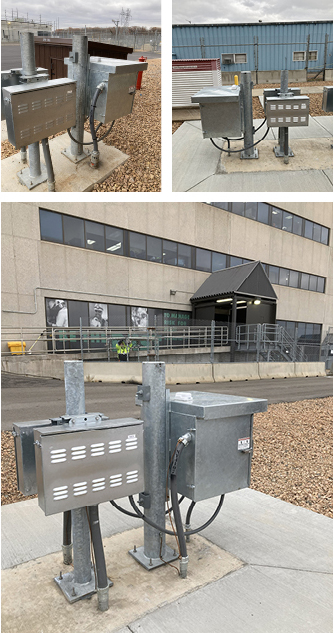
Second, six distributed anode groundbeds were added in proximity to in-scope piping to address current distribution deficiencies more directly inside the PA. Each distributed groundbed included 12 shallow vertical anodes spaced approximately 10 to 20 feet from target pipelines on approximately 25 to 35-foot centers. Finally, dedicated CP test stations were installed throughout the plant to improve the accuracy and efficiency of future effectiveness testing.
Under the Subsequent License Renewal (SLR) framework defined in 10 CFR Part 54, nuclear plant licensees must demonstrate that aging effects on in-scope structures, systems, and components will be adequately managed throughout the extended 60-to-80-year operating period. The Generic Aging Lessons Learned for Subsequent License Renewal (GALL-SLR) report identifies buried metallic piping and tanks as systems requiring active aging management.[2]
Cathodic protection systems are therefore an important corrosion mitigation measure for maintaining the integrity of buried piping systems and storage tanks throughout extended plant operation.
CP SYSTEM DESIGN BASIS AND APPROACH
The cathodic protection (CP) system upgrade was developed to address performance limitations identified during the system assessment and to support long-term operation under the Subsequent License Renewal. Design criteria were established in accordance with AMPP/NACE SP0169 and applicable NRC guidance for buried piping and tanks. The primary protection criterion was defined as a polarized potential of −850 mV CSE (instant-off) for buried carbon steel, with provisions for applying alternative criteria when justified by environmental conditions or verified corrosion rates. [2] [3]
Design assumptions incorporated the expectation that most buried metallic piping systems are electrically continuous, either by original design intent or through incidental bonding to the station grounding grid. Historical continuity testing supported this assumption and the system configuration allows for future identification and mitigation of localized discontinuities.
Site-specific constraints played a significant role in shaping the final design. Soil resistivity testing demonstrated substantial spatial variability, and shallow bedrock limited the feasible depth of remote anode installations from approximately 60-80 ft. In addition, the plant’s Protected Area contains extensive buried utilities, grounding systems, and structural foundations that influence current distribution and restrict potential installation locations. These conditions were incorporated directly into the CP system design basis.
Key Site Constraints
- Geological constraints related to shallow bedrock that limit remote deep anode well depths
- Highly variable soil resistivity across the site
- Localized high-resistivity zones at shallow depths
- Physical congestion within the Protected Area, restricting construction access and anode placement
- Extensive buried and above-grade metallic infrastructure that can influence current distribution and create shielding effects
To address these challenges, the upgraded CP system integrates existing infrastructure with supplemental anode capacity. Existing semi-deep anode groundbeds and rectifiers were retained based on their demonstrated serviceability and remaining operational life. These groundbeds continue to provide baseline current output and broad site coverage.
Supplemental distributed shallow anode groundbeds were installed at targeted locations to improve current distribution and provide localized protection for piping segments that were historically difficult to polarize. Positioning these anodes closer to protected structures reduces shielding effects from plant infrastructure and lowers the effective circuit resistance.
The resulting system reflects a hybrid current delivery strategy, combining centralized, semi-deep groundbeds with distributed shallow anodes. The rectifier distribution and circuit configuration were developed based on geographic grouping of piping systems, anticipated current demand, and constructability considerations. This configuration allows the CP system to operate as a coordinated network while enabling individual zones of influence to be balanced and adjusted during routine system maintenance.
Rectifiers were specified with sufficient voltage margin to accommodate variability in soil resistivity and circuit resistance.
The upgraded design also incorporates remote monitoring units (RMUs) installed on each rectifier. These units provide high-frequency monitoring of rectifier outputs and operating status, with data transmitted directly to the site’s MAPPro™ database for centralized access.
Remote monitoring improves visibility into system performance, supports early identification of equipment issues, and enables remote interruption of rectifiers during future effectiveness surveys.
INSTALLATION, COMMISSIONING, AND PERFORMANCE
Construction of the supplemental CP system was completed by Xcel Energy contractors, with Structural Integrity Associates providing on-site engineering oversight. Installation was completed as planned, including one semi-deep remote anode groundbed and six distributed groundbeds totaling 72 shallow anodes. Following installation, SIA performed system energization and current balancing in accordance with the site commissioning procedure developed by SIA for the project.
System performance was evaluated through the annual CP effectiveness survey conducted following commissioning. The survey was performed in accordance with established site procedures and industry guidance, with nearly 70 structure-to-soil potentials measured and evaluated against the −850 mV CSE instant-off protection criterion.
Survey results demonstrated a substantial improvement in CP effectiveness compared to pre-upgrade conditions. Before system rehabilitation, approximately 50 percent of monitored test locations met the required protection criterion. Following installation and system balancing, more than 85 percent of surveyed locations met the applicable protection criteria, with additional adjustments planned to further improve overall coverage.
Survey coverage was also expanded relative to historical testing by adding new CP test stations installed as part of the upgrade project. The increased monitoring resolution provided improved visibility into localized system performance. It confirmed that the upgraded system configuration largely mitigated the current distribution limitations identified during the assessment phase.
Post-installation rectifier operating data also indicated that sufficient voltage and current capacity remain available across the system. This operating margin provides flexibility to accommodate potential future changes in site conditions, including coating degradation, expansion of buried piping scope, or evolving regulatory expectations, without requiring major system modifications. The available adjustment capacity also allows incremental tuning of individual rectifiers and groundbeds during routine CP maintenance and annual effectiveness surveys, consistent with NACE SP0169 guidance. [3]
While overall system performance improved significantly, the post-installation survey identified several localized areas where additional optimization may further enhance protection. Planned follow-up actions include targeted system balancing, installation of additional electrical continuity bonds where necessary, selective corrosion rate monitoring, and potential installation of a limited number of additional anodes with the goal of achieving sufficient external corrosion protection on 100% of the sites in-scope buried piping and tanks.
Long-term system management will also include monitoring the remaining life of the existing semi-deep anode groundbeds. Although these groundbeds remain serviceable, not all are expected to remain functional through the end of the subsequent period of extended operation (SPEO) in 2050. Replacement of individual anode beds will be performed as needed to maintain full system effectiveness while supporting long-term use of the legacy rectifiers. The implementation of remote monitoring units will assist in tracking rectifier performance and identifying potential anode depletion, enabling timely maintenance and replacement.
LESSONS LEARNED
Key lessons from the Monticello CP system upgrade include:
- Site geology strongly influences CP design feasibility. Shallow bedrock and highly variable soil resistivity required careful evaluation of anode placement and current distribution strategies.
- A hybrid ICCP configuration can effectively balance system performance and constructability. The combination of semi-deep remote groundbeds and distributed shallow anodes provided both bulk current capacity and targeted protection in congested areas.
- Localized shielding near large structures remains a challenge. Buried piping near building foundations and structural infrastructure can be more difficult to polarize despite otherwise successful system performance.
- Early planning is essential for SLR-related CP upgrades. Evaluation of legacy CP systems should begin well in advance of regulatory deadlines to allow sufficient time for assessment, design iteration, installation, and post-installation optimization.
- Allow schedule flexibility for equipment procurement and system tuning. Rectifier sizing and installation occurred concurrently with construction due to long equipment lead times and uncertainty about highly variable soil resistivity.
SUMMARY
The Monticello project illustrates how legacy corrosion mitigation infrastructure can be strategically upgraded to meet the industry’s evolving regulatory and operational expectations for subsequent license renewal. By combining historical evaluation, targeted field testing, and practical design solutions, SIA developed an upgrade strategy that improved protection coverage while minimizing construction impacts and preserving serviceable existing infrastructure.
As buried infrastructure ages and the SLR scope expands, utilities across the nuclear industry face mounting pressure to demonstrate that legacy CP systems can meet modern regulatory expectations. SIA’s corrosion engineering specialists bring extensive experience in assessing, designing, and implementing cathodic protection systems for complex facilities. Through projects such as Monticello, SIA helps utilities develop technically defensible, cost-effective solutions that support long-term asset reliability and regulatory compliance.
To learn more about Structural Integrity Associates’ cathodic protection expertise and other advanced engineering services supporting extended plant operation, contact us or visit www.structint.com.
References
[1] U.S. Nuclear Regulatory Commission, Subsequent License Renewal, NRC Fact Sheet, Washington, DC. [Online]. Available: https://www.nrc.gov/reactors/operating/licensing/renewal/subsequent-license-renewal.html. Accessed: Jan. 2026.
[2] U.S. Nuclear Regulatory Commission, Generic Aging Lessons Learned for Subsequent License Renewal (GALL-SLR) Report, NUREG-2191, Rev. 1, Washington, DC, 2017.
[3] AMPP (formerly NACE International), SP0169—Control of External Corrosion on Underground or Submerged Metallic Piping Systems, Houston, TX, 2007.
DOWNLOAD FULL ISSUE