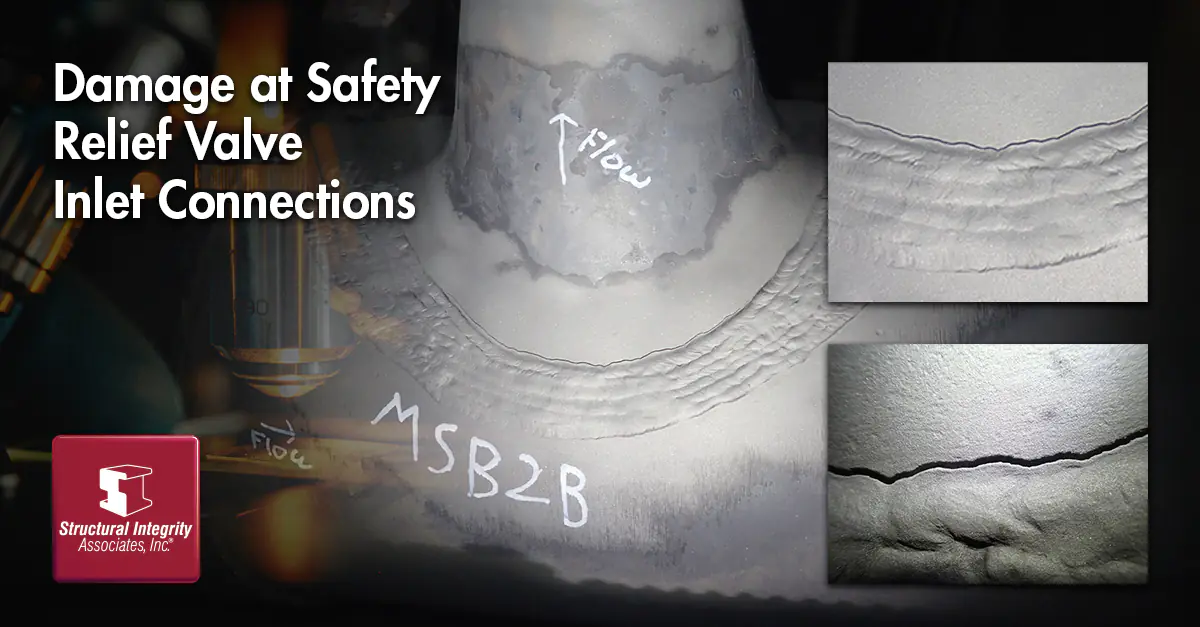
A reported failure and inspection results from a recent outage at a coal-fired unit highlighted the importance of diligent life management for welds associated with contoured integrally reinforced insert branch connection fittings used between main steam and hot reheat piping and their safety relief valves. These fittings operate in high-temperature service over 1000°F. The butt weld on the pipe side creates a local stress condition that can cause creep damage to initiate subsurface in the heat-affected zone at the flank positions. Structural Integrity Associates, Inc. (SIA) inspected a series of these welds during a May 2026 outage. The inspection results showed creep damage at varying levels. In one weld, cracking had progressed to nearly through-wall. In other welds, damage was detected at earlier stages, from incipient damage to microcracking. Subsequent inspections have since produced similar findings.
The lesson is straightforward: for this geometry and material (Grade 91 in both recent cases), knowing where and how to inspect matters. Effective assessment requires a coordinated inspection and engineering approach that can identify subsurface creep damage early, confirm its extent, and support defensible run, repair, or replace decisions.
The issue is driven by the interaction of geometry and material behavior. These fittings can concentrate stress at the flank of the connection, where creep damage may initiate below the outer surface. In Grade 91 components, the margin between an undetected condition and a flaw of consequence can be narrow, particularly when prior inspections rely primarily on surface methods or conventional ultrasonic coverage.
An effective assessment program should combine complementary inspection techniques with engineering evaluation. Depending on the configuration and condition of the connection, this may include magnetic particle testing for surface-connected cracking, linear phased array ultrasonic testing for volumetric coverage, metallographic replication to identify creep cavitation and microstructural damage, and boat sampling where destructive confirmation is warranted.
Inspection findings are only valuable if they support a decision. SIA can pair field inspection with fitness-for-service evaluation, crack growth analysis, and repair or replacement planning. This integrated approach helps owners determine whether a connection can continue operating under a defined reinspection interval, should be repaired during the outage, or should be replaced with a configuration that is better suited for long-term creep performance.
Owners of high-energy piping systems with these connections, especially in Grade 91 components or where volumetric inspection history is limited, should review whether their current assessment approach is sufficient and how urgently action is needed.
Contact us to plan an inspection and engineering analysis scope that fits your units, your next outage window, and your risk tolerance.