By: Pat Gannon and Warner Weber
INTRODUCTION
In nuclear power plants, internal linings and coatings help ensure the integrity of piping systems and maintain a barrier against corrosive environments. As part of the license renewal process, plants are required to perform internal inspections of coatings and linings to ensure that degradation does not occur.
Degradation of these coatings and linings can expose susceptible piping materials to corrosive environments, accelerating corrosion rates. Additionally, the degradation and release of internal coatings and linings as debris can result in downstream impacts on systems, such as reduced system pressure, flow blockages, and heat exchanger fouling.
Structural Integrity has developed a robust analytical approach that provides the necessary justification to alleviate the need for internal visual inspections, thereby reducing radiation exposure and minimizing system out-of-service time.
As part of the subsequent license renewal process described in the U.S. Nuclear Regulatory Commission’s NUREG-2191, nuclear power plants are required to visually inspect all internal linings and coatings for those systems that fall within the scope of license renewal. Depending on the system and location of the internal coatings/linings, these inspections can challenge personnel dose exposure goals and safety system out-of-service times and can also prove to be costly and time-intensive.
As an alternative to performing internal inspection of coatings and linings, plants may have the option to perform external wall thickness measurements. This alternative can be performed more quickly, while eliminating the need to remove safety systems from service.
In accordance with the guidance in aging management program XI.M42 of NUREG-2191, to perform external thickness measurements in lieu of internal visual inspections, the conditions shown in Figure 1 below must be met:
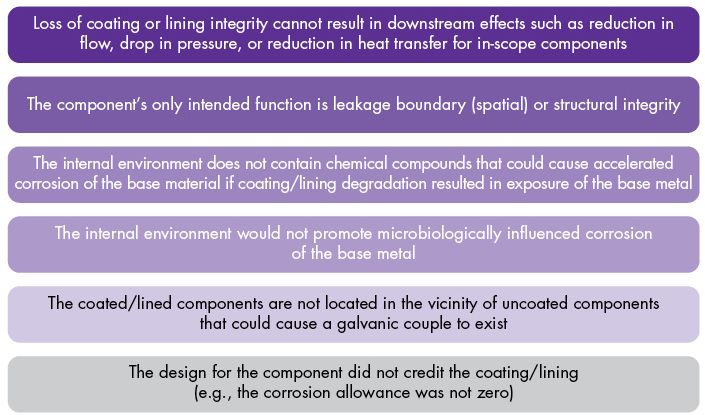
Structural Integrity Associates’ comprehensive approach for evaluating in-scope coatings and linings addresses each of the requirements stipulated in the XI.M42 aging management program (AMP).
DETERMINATION OF COATING LINING FAILURE MECHANISMS
Internal coatings and linings can be found in both water- and oil-based systems, including nuclear safety-related cooling water and diesel fuel oil systems. In many cases, these linings were supplied with the original piping during plant construction or were applied at the beginning of commercial operation. Often, these coatings and linings have reached or exceeded their original qualified life.
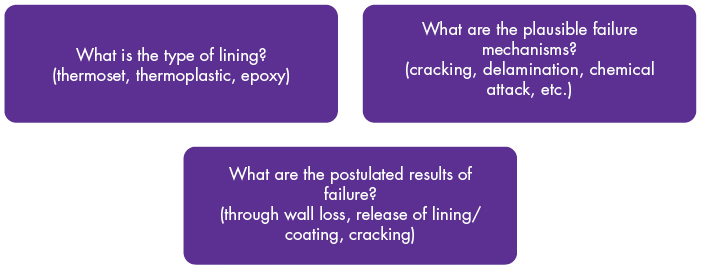
SIA personnel have experience evaluating a range of internal coatings and linings, from cured epoxies to extruded polypropylene-lined piping. By understanding the nature of the installed coating/lining, plausible failure modes can be determined.
DESIGN CONSIDERATIONS FOR EVALUATING LINING FAILURES
Evaluation of System Impact
To justify performing external thickness measurements in lieu of internal visual inspections, it must be determined that a release of the coating or lining does not impact downstream system functions.
SIA personnel have a strong technical understanding of the licensing basis functions for the various systems within the scope of license renewal. By understanding the system design functions, their performance margin, and the nature of the release of failed coatings/linings, the impact on downstream components can be assessed. When assessing the potential impact of coating/lining failures, a worst-case failure of the lining is evaluated.
Assessment of System Corrosion Susceptibility
To eliminate the need for internal visual inspections of coatings and linings, it must be determined that the underlying piping is not susceptible to accelerated corrosion rates due to chemical attack, microbiologically influenced corrosion, and/or galvanic corrosion. By providing a holistic evaluation that assesses the chemical environment, material susceptibility, and design requirements, SIA can provide a comprehensive evaluation of the piping corrosion mechanisms and corrosion allowance.
CONCLUSION
Effective management of coated and lined systems under license renewal requires a clear understanding of service environments, degradation mechanisms, and the structural margins necessary to support continued operation. By evaluating coating and lining performance in the context of system chemistry, corrosion rates, and minimum required wall thickness, a technically supported basis can be established for alternative inspection strategies. When appropriately justified, external wall thickness measurements can provide a reliable indicator of structural integrity while satisfying the intent and conditions of XI.M42 in NUREG-2191.
SIA’s nuclear materials and corrosion specialists support utilities in developing these defensible technical evaluations. Through detailed degradation assessments, corrosion rate analyses, and minimum thickness determinations, SIA helps plants establish regulatory-compliant alternatives to certain internal visual inspections. This approach maintains alignment with license renewal requirements while supporting safe operation, improving outage efficiency, and preserving system availability.
Structural Integrity Associates’ process ensures adherence to the XI.M42 conditions in NUREG-2191. SIA’s robust and comprehensive analytical approach of wall thickness measurements helps plant and asset managers alleviate difficult internal visual inspections while:
- Adhering to auditable regulatory expectations
- Reducing radiation exposure
- Minimizing system out-of-service time
- Improving safety and lessening operational risks
Learn more about SIA’s capabilities in our linings and coatings assessment brochure.
DOWNLOAD FULL ISSUE