By: Ashkan Nejad, Ph.D. and Andy Crompton, PE
Industry experience shows that vibration-induced alternating stress at the socket weld toe or root is a key contributor to these failures. Common mitigation approaches include improving the socket weld profile from 1:1 to 2:1 to reduce the fatigue strength reduction factor (i.e., improving fatigue performance) or by adding stiffness through tiebacks or rigid supports. While these methods can reduce vibration locally, they are often time-consuming and costly, require additional calculations and follow-up testing, and may introduce new vibration modes or shift the problem to other locations in the system.
This article examines the problem from a different viewpoint and explores a new mitigation approach based on engineering understanding and lessons learned from industrial experience. The focus is on evaluating whether a combined stiffness and damping strategy can provide a more effective and practical solution for reducing vibration in small-bore piping systems.
ANALYTICAL SCREENING AND EXPERIMENTAL VALIDATION
The study (1) began with analytical screening. Finite element modeling was used to evaluate several novel candidate mitigation concepts before any physical testing was performed. This approach enabled efficient comparison of different configurations and reduced the time and cost associated with fabricating and testing multiple designs. The models focused on cantilevered small-bore attachments connected to large headers, which are commonly associated with field failures.
The analytical results showed that adding stiffness alone, such as through tie-back supports, can reduce vibration response at a specific location but often introduces additional low-frequency modes at other locations. These modes may be excited by common vibration sources such as blade passing frequency or shear layer–related excitation.
In total, 10 different mitigation concepts were selected and modeled using various finite element techniques. These included clamshell-type supports, wire or cable supports, tie-back structures incorporating viscoelastic or shock-absorbing elements, variations in socket weld joint material properties, and approaches focused on increasing damping using polymer-based viscoelastic materials. The results showed that configurations combining structural stiffening with added damping reduced vibration response over a broader frequency range without introducing unfavorable dynamic behavior. Based on this screening, a steel cone shell support with internal polymer infill was identified as the most effective and practical option and was selected for experimental validation.
To identify a suitable high-damping material, this work was performed in collaboration with the Electric Power Research Institute (EPRI) to evaluate polymer candidates that could provide improved vibration mitigation performance. Damping behavior in dynamic systems is inherently nonlinear, which makes material selection challenging and difficult to predict using analytical methods alone. For this reason, three candidate polymer materials were selected for experimental evaluation.
The damping behavior of these materials was examined using the well-researched ASTM E756-05 standard method with an Oberst beam test configuration. The samples were tested using both impact excitation and shaker-based random vibration input to characterize their dynamic response over a range of frequencies. The results showed a high level of nonlinear behavior in the damping response of the materials, particularly in terms of energy dissipation across different modes and frequency ranges. For some samples, damping performance varied significantly with frequency, making the response difficult to predict and less reliable for practical application.
One polymer material demonstrated consistent damping performance across the first three bending modes of the Oberst beam and was therefore selected for further use. This polymer was then incorporated into the cone support design for the small-bore piping application. The cone geometry was developed using 3D scanning of the pipe assembly, and the polymer infill was fabricated using 3D printing techniques to achieve a close fit and consistent material distribution.
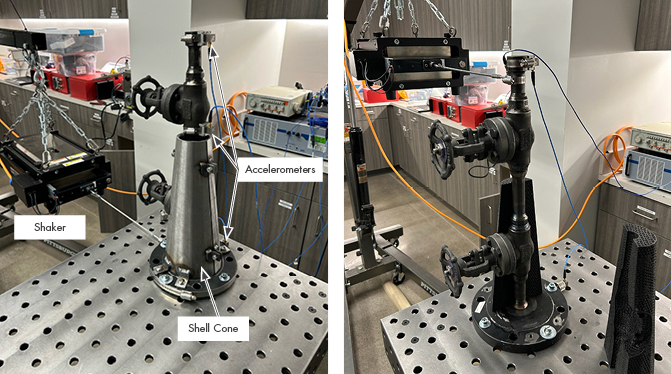
A full-scale small-bore piping assembly, representative of a typical vent line, was subsequently fabricated and tested. Modal testing was conducted to validate the finite element model used for vibratory stress analysis. Random vibration testing using shaker excitation showed that the cone–polymer support increased natural frequencies, significantly increased damping, and reduced vibration response and vibratory displacement near the socket weld.
These experimental results indicate that the cone–polymer support altered the system behavior in a way that reduced resonant amplification at fatigue-critical locations and improved overall vibration performance
VIBRATION AND STRESS REDUCTION RESULTS
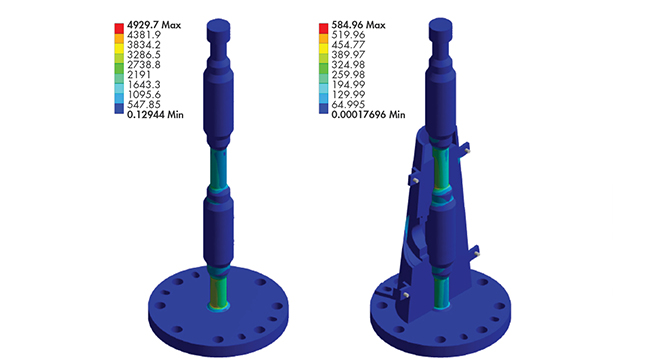
Random vibration testing demonstrated reductions in vibrations of up to approximately 46 percent at key locations, depending on direction. The measured excitation data were then used directly as input to correlated finite element random vibration analyses. This allowed stress response at socket weld locations to be evaluated under realistic loading conditions.The combined test and stress analysis results showed a strong reduction in stress response across the dominant frequency range.

Equivalent stress at critical socket weld locations was reduced by approximately 94 to 95 percent when the cone support was installed.
The analytical predictions followed the same trends observed in the measured vibration data, providing confidence that the observed vibration mitigation translated directly into meaningful reductions in weld stress and fatigue susceptibility.
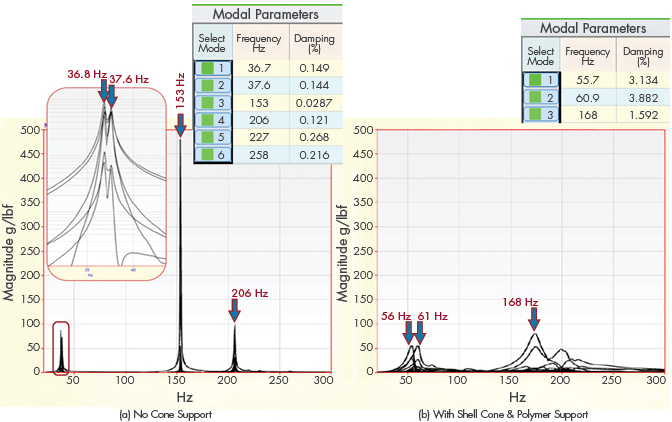
FIGURE 3A. Experimental modal testing of baseline vs cone-supported response, frequency shift, and damping increase
CONCLUSION
SIA, in collaboration with EPRI, approached a longstanding problem from a different perspective and explored a new mitigation approach grounded in engineering understanding and lessons learned from industrial experience. The results of this effort show that effective vibration mitigation for small-bore piping may be achieved with more than stiffness alone. Combining structural stiffening with damping provides a robust and practical means of reducing vibration-induced stress at socket weld connections.
By using analytical screening to guide targeted testing, the study reduced development effort while improving confidence in stress-based decisions. The cone shell support with polymer infill evaluated in this work represents a viable passive mitigation option for small-bore piping systems, particularly for retrofit applications in operating plants.
Equally important, this work reflects the value of SIA’s active participation in collaborative industry research. Through partnerships such as this one with EPRI, SIA can directly address recurring operational challenges, deepen its technical expertise, and develop practical, field-applicable solutions. These efforts not only resolve specific issues such as small-bore piping vibration but also advance industry knowledge and strengthen the technical capabilities SIA brings to its clients.
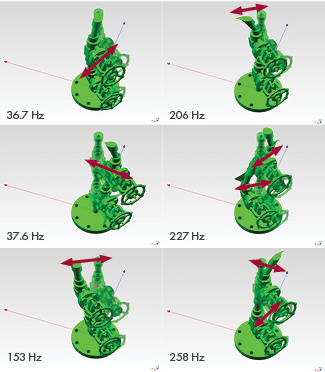
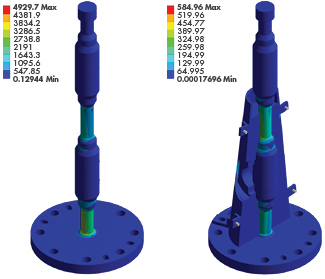 Figure 4. FEA Based Vibratory Stress Analysis Of A Small Bore Cantilever Pipe Under Base Random Vibration Excitation Us…
FIGURE 4. FEA-based vibratory stress analysis of a small-bore cantilever pipe under base random vibration excitation using shaker test input. Comparison is shown between the baseline configuration and the cone–polymer supported configuration.
ACKNOWLEDGEMENT
[1.] This work was performed by Structural Integrity Associates in collaboration with the Electric Power Research Institute (EPRI), with Stephen Tate as the project manager. The authors acknowledge EPRI’s technical guidance and support in advancing vibration mitigation approaches for small-bore piping systems and in enabling the analytical and experimental efforts described in this study.
DOWNLOAD FULL ISSUE