

Metallurgical Lab – Industries

SPECIALIZED ANALYSIS

SPECIALIZED ANALYSIS

Structural Integrity has been providing services to the power generation industry since our founding in 1983. Our Materials Laboratory provides metallurgical services to hundreds of power industry clients, and often works in support of SI’s various engineering groups. At SIA, we have the ability to combine engineering principles across multiple disciplines (metallurgical, mechanical, chemical, etc.) to ensure clients receive the most accurate and comprehensive results and recommendations in the industry. We work with power industry OEMs and owners/operators and have performed thousands of metallurgical analyses of component failures from power plants throughout the world. SIA is well known for helping clients assess damage mechanisms, determine failure root causes, and provide successful, cost-effective asset management solutions. Typical components include:

Petrochem/Process Plants

Petrochem/Process Plants

The chemical processing industry covers a broad range of manufacturers and processes, and numerous chemical substances and products. SIA’s scientists, engineers, and technicians have many years of experience evaluating components from petrochem and process facilities, from rotating equipment to furnace tubing to exotic alloy parts in specialty processes. In addition, SIA’s background in power often comes into play in support of electrical and steam generating systems within these facilities. Our knowledge also encompasses common equipment and components, such as fans, pumps, fasteners, shafts, structural sections, welds, and many other plant components.

Oil & Gas

Oil & Gas

SIA’s Materials Laboratory supports the oil and gas transmission pipeline industry by performing a variety of metallurgical testing and analyses on damaged pipe and equipment. Our knowledge of pipeline manufacturing history, longitudinal seam and butt weld issues, and common corrosion mechanisms allows us to effectively support clients in the oil and gas transmission industry. In many cases, our metallurgists coordinate directly with engineers from our Oil & Gas Pipelines division to provide metallurgical testing and field support related to material verification and assessment.

General Industry

General Industry

The failure analysis process is essentially a standard methodology for assessing damage mechanisms and causative factors. SIA’s Materials Laboratory staff applies this process within a variety of general industrial environments related to manufacturing facilities and products, construction sites and equipment, and commercial property assets. Our materials expertise is often applied to failures involving equipment and components that are common to multiple industries, including fans, pumps, piping and tubing, fasteners, shafts, structural sections, welds, etc. Industries supported include:

Insurance

Insurance

SIA’s independent scientists and engineers can provide technical support to claims adjusters evaluating complex losses. Our experience can be leveraged to understand the cause and extent of damage to industrial components or facilities. Our staff of metallurgical experts understands the importance of assessing damage and failures in the framework of multi-party investigations, and, when necessary, our technicians can provide independent laboratory testing services under the direction of non-SI metallurgists and consultants.

Legal Support

As an independent laboratory with extensive expertise in component evaluation, failure analysis, and materials engineering, SIA offers litigation support services that range from providing technician and laboratory support to preparing and managing unique and complex test protocols with multiple parties present. SIA also has engineers and scientists with expert witness experience, including giving deposition and trial testimony. Many of these individuals are licensed engineers and/or have advanced degrees.

Reducing Vibration-Induced Stress in Small-bore Piping Using Damped Support Systems

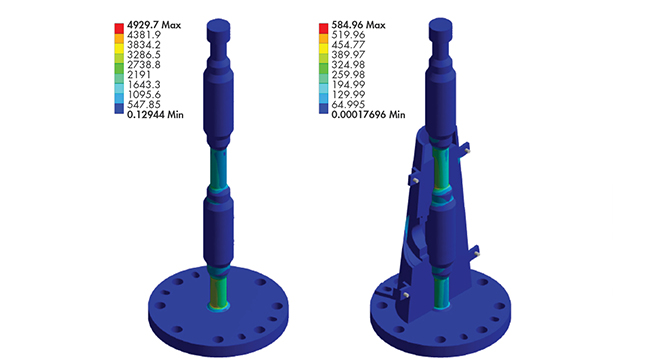
By: Ashkan Nejad, Ph.D. and Andy Crompton, PE INTRODUCTIONSmall-bore piping continues to be a common source of vibration-related issues in operating plants, particularly at socket weld connections on cantilevered drain, vent, and sensing lines. These configurations often include valves or actuators that increase dynamic response and thereby make the weld locations susceptible to high-cycle fatigue. Industry experience shows that vibration-induced alternating stress at the socket weld toe or root is a key contributor to these failures. Common mitigation approaches include

Learn More

Lining and Coatings Degradation Assessments in Supporting Nuclear Power Plant Licensing Renewal Applications 

By: Pat Gannon and Warner Weber INTRODUCTIONIn nuclear power plants, internal linings and coatings help ensure the integrity of piping systems and maintain a barrier against corrosive environments. As part of the license renewal process, plants are required to perform internal inspections of coatings and linings to ensure that degradation does not occur.   Degradation of these coatings and linings can expose susceptible piping materials to corrosive environments, accelerating corrosion rates. Additionally, the degradation and release of internal coatings and

Learn More

Siemens 13.9m² Disk Bore Keyway Nondestructive Examination Re-development

SIA’s Holistic Approach to Rotor Life Assessments Structural Integrity Associates validated automated PAUT to achieve 100% disk bore/keyway coverage on Siemens 13.9 m² rotors—within a predictable five-day outage—supporting defensible life assessments without de-stacking.   By: David Dechene and Nick Dechene INTRODUCTION The Siemens retrofit 13.9 m² rotor is a 1,800 RPM double-flow, low-pressure (DFLP) turbine rotor commonly used by nuclear utilities for power generation. This rotor is a built-up design, meaning it has a shaft with three shrunk-on wheels (or

Learn More

Search...